Late in 2024, I had the privilege of visiting the Ashmolean Museum. The last time I’d visited, back in about 2018, I’d been blown away by the range of artefacts on display. This time, I was with colleagues and we were tasked with finding an object to discuss over lunch.
I could’ve chosen a variety of different objects, from the various paintings on display to the fabrics from across the world, but I felt myself drawn to these chairs that were on display:
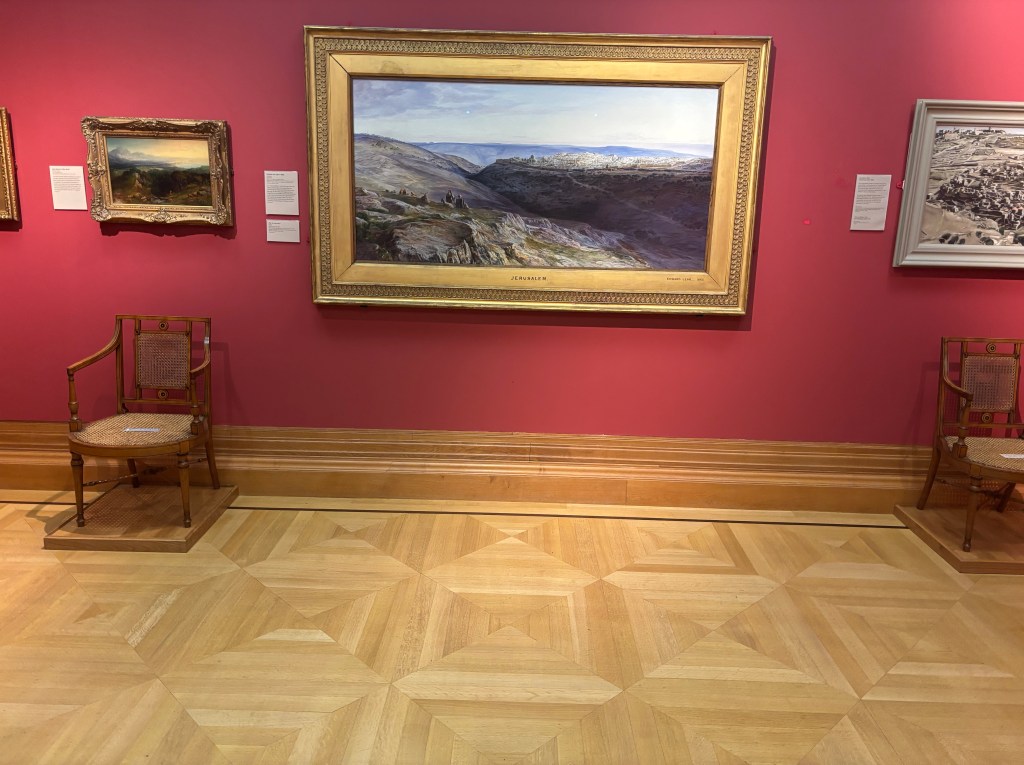
Situated within a landscape of Jerusalem by Edward Lear, I wanted to know why the chairs were not designated for visitors and what their history was. I’m so glad I did! These armchairs were gifted by Lady Henriques in memory of her son, Second Lieutenant Philip Brydges Henriques. He had matriculated from New College, Oxford, and was killed in action on 24 July 1915 aged 20.
It appears the family opted to have a number of war memorials to their lost son, including one within St Mark’s Church in Guildford. What is particularly interesting about the memorial in St Mark’s Church is the background of the family: Lady Beatrice Henriques had been born Beatrice Rachel Faudel Phillips, and her father was Sir George Faudel Philips, 1st Baronet. Their family were Jewish, and some of Lady Beatrice’s vast collection of objects are now cared for by a variety of museums.
It appears her family contributed to the First World War in a variety of ways, with her husband Sir Philip acting as Deputy Director General of Munitions Finance and Controller of Aircraft and Explosives Finance. In 1918, he became Assistant Financial Secretary in the Ministry of Munitions and was knighted for his wartime work. Although it does not appear that the family regularly attended St Mark’s Church, it was the place of worship that was local to their home which may explain why they chose to have another memorial for their son there.
Second Lieutenant Henriques now lies at rest in Lijssenthoek Military Cemetery in Belgium. His headstone does not have a religious emblem; some have suggested that this was at the family’s request, having seen the rise in antisemitism in the 1920s and 1930s and wishing to protect their son’s grave from desecration. However, this cannot be corroborated. Moreover, his grave is separate from other war dead; it may be that initially plans were to have separate areas for different religious groups within the cemetery, or to have officers and non-commissioned ranks kept separate throughout the site, but nevertheless his grave is well-visited. I found this additional information particularly poignant when considering the placement of the chairs between the landscape of Jerusalem.
Next time you visit the Ashmolean Museum, make sure to look at these chairs, and perhaps you know of more museum artefacts that can be considered as memorials to the two World Wars. I’d love to hear about these!
Further Reading
https://astreetnearyou.org/person/144688/Second-Lieutenant–P-B-G-Henriques
https://www.cwgc.org/find-records/find-war-dead/casualty-details/144688/p-b-g-henriques/
https://www.iwm.org.uk/memorials/item/memorial/23346
https://www.jewsfww.uk/philip-brydges-gutterez-henriques-1550.php
https://www.surreyinthegreatwar.org.uk/collections/getrecord/SHMEM_W_M_1635
https://collections.vam.ac.uk/item/O112558/the-henriques-house-dolls-house-unknown/
 Dr Megan Wang (née Kelleher)
Leave a comment